Wednesday, 21 August 2013

Troll station, Antarctica: obviously, Norwegian


Troll Station is a Norwegian research station in the north of Antarctica, 235 kilometers from the coast in the eastern part of  Queen Maud Land.

The sector named Dronning Maud Land was annexed by Norway on the 14 January 1939.


Troll Station is Norway's only all-year research base in Antarctica, and is supplemented by the summer-only station Tor (just a small container shelter and lab).
Troll is operated by the Norwegian Polar Institute (Polaristitutt) and also features facilities for the Meteorological Institute and the Institute for Air Research.


Troll station opened as a summer-only station in 1990 and was taken into use as an all-year station in 2005. Norway sent two major expeditions to the territory in the 1940s and 1950s.


Location: 72° 01′S, 2° 32′ E , some 3800 km from the Souh Pole.
Occupation: 8 to 30, max. ~ 60 research crew.


The main building consists of improved red containers assembled on stilts. Other countries had more imagination in creating special buldings.


Contrary to most other research stations on the continent, Troll is placed on a snow-free slope of solid rock breaking through the ice sheet, the Jutulsessen nunatak, 1275 meters above mean sea level.


The main building has eight bedrooms, a gym, a sauna, a large kitchen, a communications center and office spaces available for overwintering.


Several separate buildings that house laboratory supplies store, aggregate plant and garage, as well as a the auxiliary with room for eight people listed in safe distance from the base in case of fire or other accidents.

With luck, an outdoor bathtub and a sauna heated by excess heat from the power generator are available luxuries.

The station is also equipped with several vehicles like snowmobiles and tracked-tractors.

A researchers' convoy, pulled by belts driven by tracked vehicles.

The station under tempestuous catabatic winds.

The Polar Institute runs the research station and conducts meteorological and atmospheric measurements.

The base has a meteo station, a radiation source for measuring including UV radiation, and a field station for glaciological, biological and physical field program.

---------------------------


Troll Station is presently served by Troll Airfield, a 3000 meter long airstrip that was built on blue ice, 7 kilometers north from the research station.

The airfield runway has capacity for large planes like H C-130, Ilyushin 76 or even (recently) a Boeing 737.


Troll airfield's path must be regularly maintained using icescraper and snow clearing machines, but the dominant wind direction from east helps to keep the path free of snow most of the year.


Being located south of the Antarctic Circle, Troll has midnight sun in the summer and polar night during the winter.

Austral Auroras, or Southern Lights, can be seen here in the antarctic winter, March to September:


Sunday, 11 August 2013

Paulatuk, the blue inuvialuit hamlet by the 'Smoking Hills' of Franklin Bay


Paulatuk is located 400 km east of Inuvik, near the mouth of the Hornaday River(*). The town is the main doorway to the Tuktut Nogait National Park, in the northeast corner of the Northwest Territories of Canada, and partly in the neighboring Nunavut region.


Paulatuk was founded in the 1920's on the site of an inuvialuit (native inuit population) hamlet on the Northwest Territories; it was named for the coal resources of the Darnley Bay area, which is also rich in several metals.


Population  ~300
Coordinates: 69°21′ N, 124°04′ W


Darnley bay is a large inlet of the Amundsen Gulf arctic waters, 170 km north of the arctic circle.

The residential houses of Paulatuk are typically blue-painted.


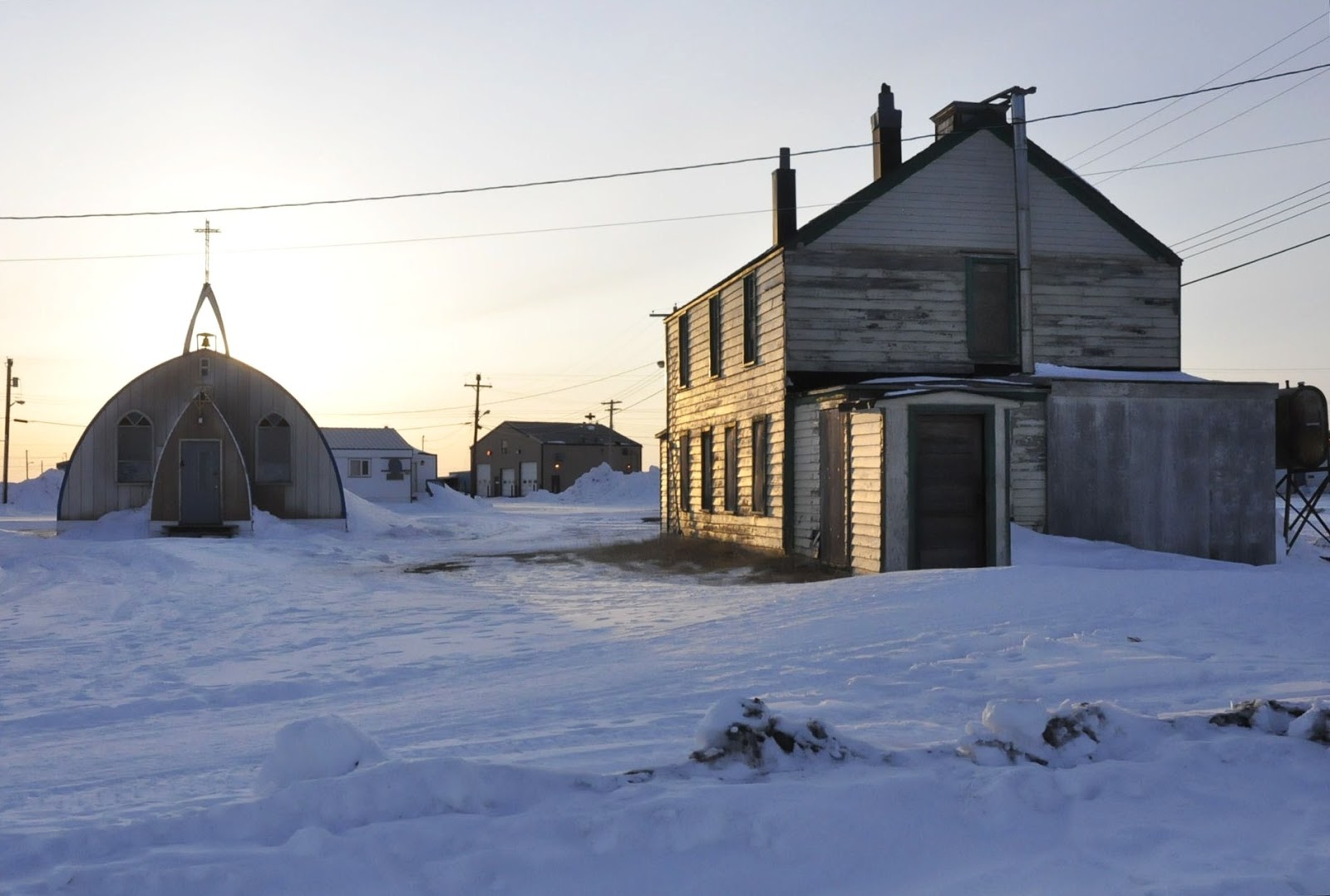
The rather unusual church, from 1936. 

Hudson Bay Company started an outpost at nearby Letty Harbour in 1930, but it didn't las long and was closed in 1937. By that time, a catholic Mission took over in Paulatuk as a small trading post. But only in the mid 1960's most people in the area came to Paulatuk, where government started building houses, school, a health center and other facilities.

The Paulatuk Center houses the community's Hotel, the Northern store and offices. There is also a shop for the native artwork - prints and carvings.


The Post Office

The Church and the old catholic trading post where the town began.


Many traditional activities, such as drum dancing, sewing, and land-based skills, have been revived through the work of elders community members.


Hunting, fishing and trapping are major economic activities, but in recent years art printmaking hand carving as played an increasing role in the local economy.

Returning home in late afternoon, on the frozen waters of Darnley Bay.


Paulatuk is not far north from the arctic circle, so the 'long' polar night here is rather short, less than two months.


The small airport has recently been improved with a new terminal building:

----------------------------

From Paulatuk, the Smoking Hills of Franklin Bay are about 105 km west on the shores of the Arctic Ocean.


Trips on Darnley Bay and to the Smoking Hills depart from Paulatuk in the summer months. The major inconvenience is the mosquito plague in warm weather.

(*)
HORNADAY River and the TUKTUT NOGAIT PARK


The Tuktut Nogait national park is located 170 km north of the arctic circle, on the Northwestern Territories of canada, at 68º N, 121º W.
This is one of the most remote parks in Canada, with vast expanses of tundra and deep canyons,  scenic waterfalls and crystal clear rivers.

The Hornaday River's canyon

The Hornaday canyon, east of Paulatuk .


La Roncière Falls (69°08′N, 122°52′W) is a 23 m waterfall on the Hornaday.

This is one of the most spectacular sites in the park.


As the river approaches its mouth, it starts meandering through the tundra flatland into a final large delta.

The river empties calmly into Amundsen Gulf's Darnley Bay, 14 km east of Paulatuk.


Aerial view of Paulatuk