Sunday, 3 November 2013

Three norse sailors at 72° 57′ N :
the runic stone from the 13th century found at Kingittorsuaq


In 1434, the Portuguese navigators doubled the dreaded Cape Bojador, just close to home, then they soon connected the Atlantic to the Indian ocean round the Cape of Good Hope and found the route to India ; right, fine, but norse Viking sailors, at least three of them, sailed round cape Farvel (Uummannarsuaq) at 60º N , circumnavigating Greenland by the south end, and reached Kingittorsuaq, a small islet facing the settlement of Upernavik.

And at the time they were yet ... in the Middle Ages (13th century).

That is brave !


They sailed and rowed up to 72° 57′ N. Seventy three degrees north. Something almost unthinkable (The arctic circle is at 63º N).


This was probably the longest distance the Vikings reached northerly bound, in fragile little sail boats (fast though), through an harder Ocean than the South Atlantic - a frozen sea of ice floes and icebergs.

And on they went, until the mythical Helluland told in the Sagas - we know now it was big Baffin Island, already  in North America.

The Viking navigators reached further north than was thought, sailing through the Davis Strait, on the West coast of Greenland.

The late 12th century 'Historia Norvegiae' tells us of one of the first encounters of norse hunters with eskimo people in east Greenland:

'On the other side of Greenland, toward the North, hunters have found some little people whom they call skraeling; (...) they have no iron at all; they use missiles made of walrus tusks and sharp stone for knives.'

The Runestone of Kingittorsuaq dates likely from the mid-13th century. It was found in 1824 at the highest point of the island, a group of three piles of stones (cairns) forming an equilateral triangle.


Kingittorsuaq island is no more than an uninhabited rock in Northwest Greenland, on the banks of the Upernavik fjord, near its estuary's opening to Baffin Bay.

The dating of the runestone has varied between 1135 and 1314. It is an almost flat stone with three lines of the Norse characters. Vikings used these inscriptions for various purposes: a memorial to the dead, the marking of territory, or to describe major events (such as travels).

National Museum, Copenhagen 


In Greenland alone more than 100 runestones were found. Contrary to some beliefs, none of these testimonies of Norse presence was arguably found in American territory.

So, this is how it was: sometime, by the 13th century, three Viking sailors were on Kingittorsuaq by early spring, having most certainly wintered there. And before departing they left a message, a silent testimony on stone, worked with hands burned and calloused from the intense cold.


And the inscription says:

«Erlingur Sigvatsson, Bjarni Thordarson and Enridi Oddsson erected here three cairns on a Saturday before Rogation day»

[25 April, day of St. Mark in the Christian calendar - an important holiday in medieval times]


On Upernavik, I've posted before here


Tuesday, 22 October 2013

Rothera ,
a small British village in Antarctica


Rothera Research Station is a British Antarctic Survey (BAS) base on the Antarctic Peninsula, located on a small rocky beach of  Adelaide Island.


Rothera also serves as the capital of the British Antarctic Territory, including Signy, Halley, King Edward Point and other smaller stations.

Rothera base, encircled in the red line

Adelaide Island lies approximately 1630 km south east of Punta Arenas in Chile. It's heavily glaciated with mountains of up to 2565 m height. The station is built on a promontory of rock at the southern extremity.


The station has a 900 m crushed rock runway, with an associated hangar and bulk fuel storage facility, and recently also a wharf for the discharge of cargo from supply ships.


Rothera is home to well-equipped biological laboratories and facilities for a wide range of research: the work disciplines represented on the station include marine and terrestrial biologists, meteorologists, electronics engineers, dive officer, boating officer, chef, doctor, vehicle and generator mechanics, electricians, plumbers, builders, field assistants, communications managers and of course a station management team.

The ID at the door of  Old Bransfield House

Location:  67° 34’ S,  68 ° 08’ W
Occupation: average 22, maximum 130.

Occupied since 25th October 1975


Since 1980, the station provides accommodation, a community service hall, electrical power generation, vehicle workshops, scientific offices and stores for food and travel equipment.
It's open throughout the year - a small British village in a ice-desert landscape far away from anywhere else.


Bedrooms are situated in Admiral's House and in Giants House (above), with communal wash rooms.


New Bransfield House, the larger building, provides dining, social and recreational facilities for the people living at Rothera. It also houses offices and labs for the physical scientists and at the north end is found the operations control tower.

Meals are taken communally in a central dining room. Lunch and dinner are prepared by the station's chefs.

The airfield's distinctive yellow control tower.

From inside, the view of an unfriendly antarctic landscape.


The aircraft hangar will accommodate the Dash 7 and Twin Otter aircrafts protecting them from the harshest weather.

A BAS 'Twin Otter' over Rothera.

At the southern end of the site you will find the Bonner Laboratory, the boat shed and the  new Wharf where ships can safely moor in ten metres of water for the transfer of cargo and personnel.


The Bonner Laboratory, opened in the summer 1996-97, has an incorporated dive facility for the study of marine and terrestrial biology.


The dive programme continues year round with divers accessing the water through holes cut in the sea ice during the winter. The Bonner Laboratory is equipped to an extremely high standard for biological research.

Ocean Nova moored at Rothera

The BAS ships visit Rothera at least twice each summer bringing passengers as well as cargo. Usually RRS James Clark Ross (the ‘JCR’) arrives in December to resupply the base, and RRS Ernest Shackleton (the ‘Shack’) visiting in March. Ship visits are particularly important as they are the way to receive essential supplies - food, fuel, scientific equipment, vehicles, spare parts for machinery, building materials...

BAS ship RRS James Clark Ross docks at the wharf to offload cargo and passengers.

There is always plenty of work to do on an Antarctic station. But they manage somehow to have a pleasant time, and even music sessions in Fuchs House music room or, weather helping, out in the blue ice, as in this rehearsal of 'Nunatak' for 'Live Earth' concert - Antarctica:


--------------------------------------------

Winter in Rothera can be really long...

... under perpetual darkness and unbearably cold temperatures.

Lemaire Channel under the Midnight sun


and in Christmas Eve.


BAS:
http://www.antarctica.ac.uk/about_bas/our_organisation/who_we_are.php


Sunday, 29 September 2013

Chefornak, Alaska :
Drum dancers and grass baskets


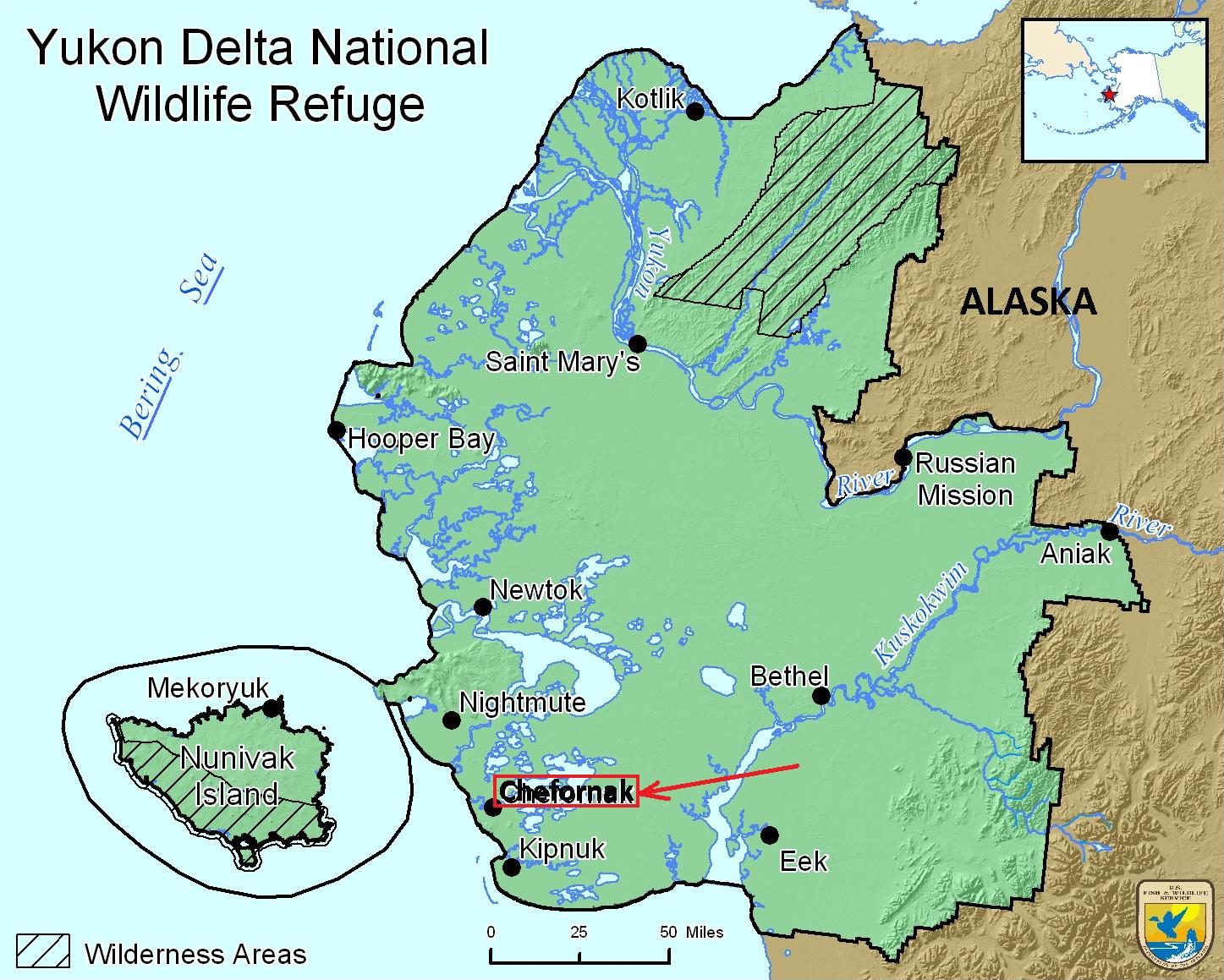
Chefornak is a small coastal town in Alaska's subarctic tundra territory, on the south bank of the Kinia River, an arm of the Bering Sea.


Coordinates: 60°9′N, 164°16′W
[ more than 700 km south of the Arctic Circle ]
Population:  ~ 480


Chefornak is a traditional Yup'ik Eskimo community; many of the villagers live a subsistence lifestyle, basically traditional hunter-gatherer activities. They rely mainly on halibut, salmon and herring, rabbits and birds, but in recent years Yup'ik art is a growing source of income.


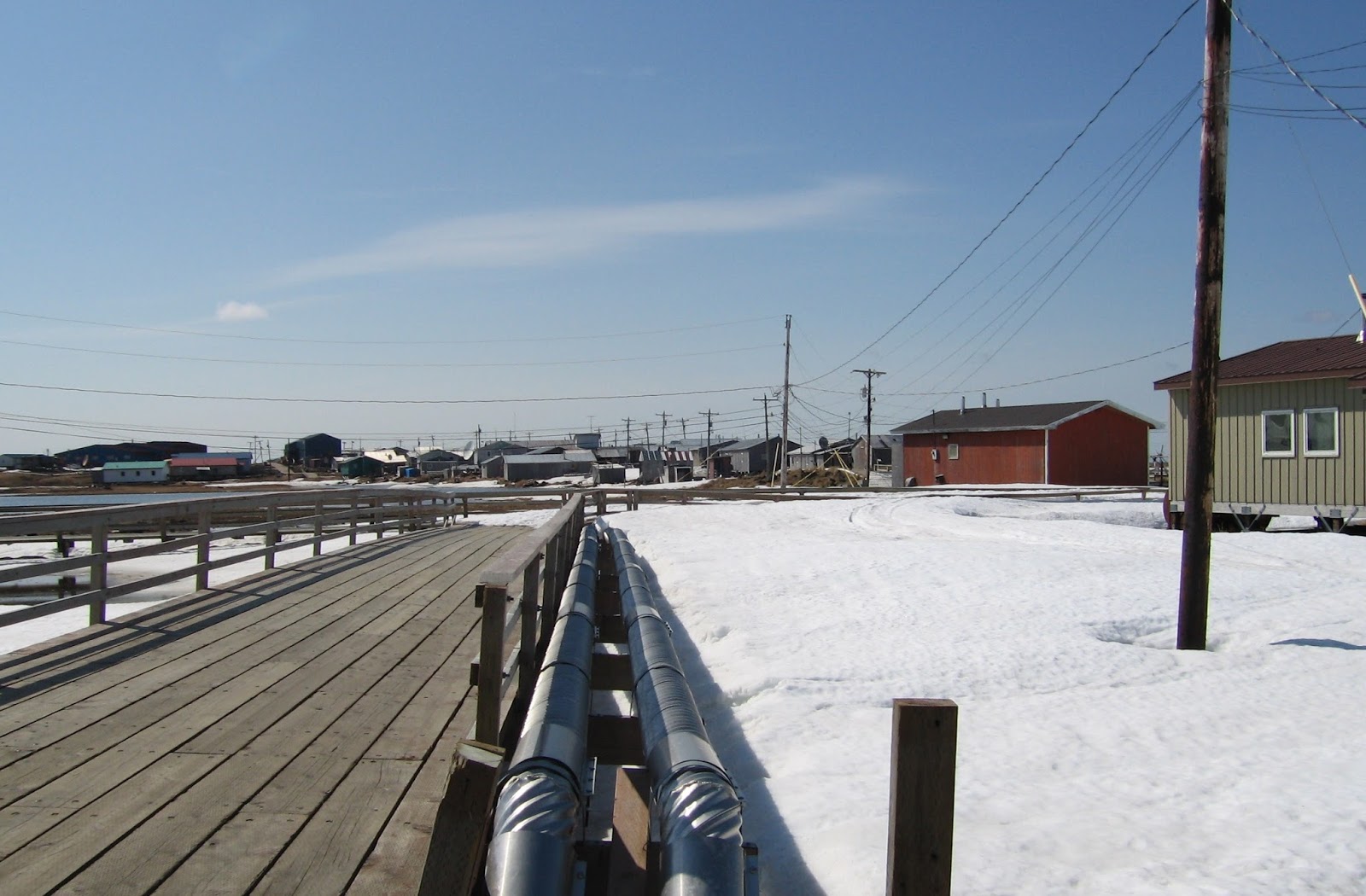
On the vast expanse of tundra, Chefornak is but a cluster of plywood houses, a post office, a school, a church, all connected by wooden boardwalks.


A wooden boardwalk runs through the village, from the school at one end to a church at the other, connecting some two dozen houses.

Some 'Public Watering Points' are placed along the boardwalk. Clean water is one of the main problems in town.

The Kinia River (Urrsukvaaq) and its many tributaries are vital to the people of the village, allowing water travel and areas for hunting and fishing, but on the other hand they cause frequent floods implying undesired dislocation.

School
Probably the best building in town, it's a modern and comfortable school made to improve standards of life, but respecting the native Yup'ik lifestyle.

Post Office


Community Service Center

St. Catherine of Siena Catholic Church

Artists of Chefornak

Jane Wiseman gathers a variety of grasses along the banks of the rivers near her village, to craft exquisite finely coiled grass baskets:

Jane Wiseman hand treats and dyes the grasses and weaves baskets, bowls and trays.

Mary Jane Joseph, Grass Basket


Pauline Jimmy, a coiled grass basket

Joan Tenenbaum, Raven in flight

Joan Tenenbaum, pendant

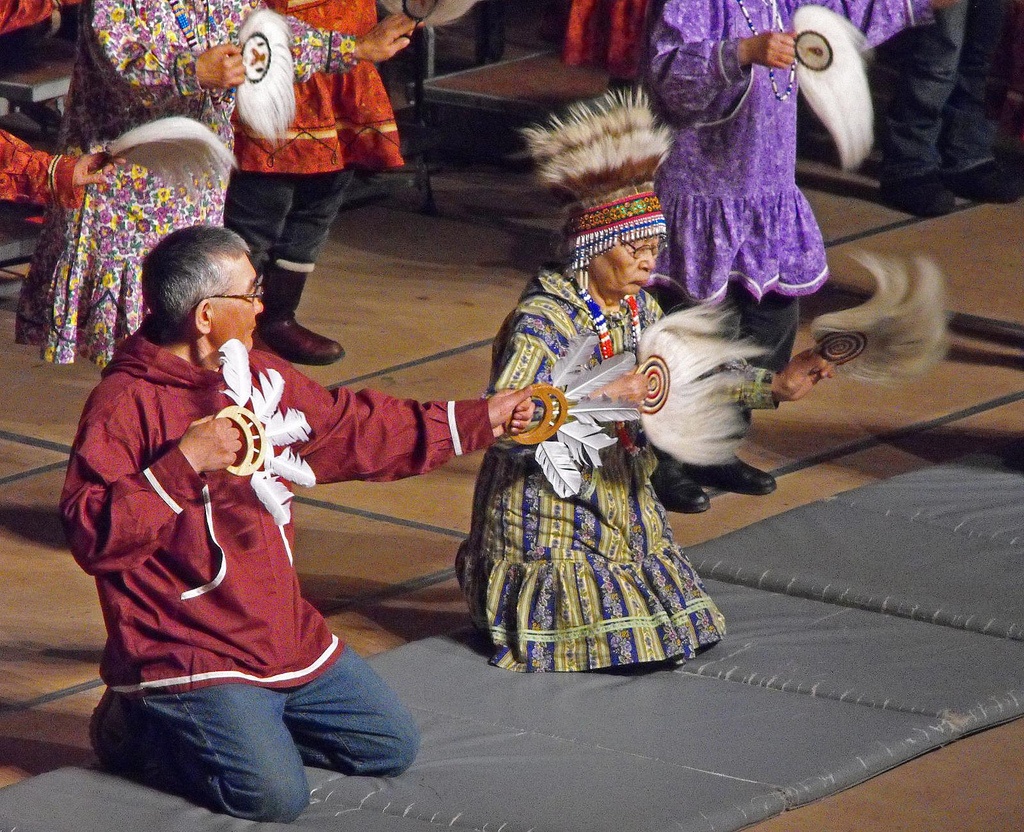
A popular activity in Chefornak is Yup'ik dancing. The high school has a dance team that visits other villages for feasts and festivals.

Traditional dance.

Women use dance fans made of woven grass and caribou feathers, while men use a ring-style dance fan made of wood and feathers.

A Yup'ik man dance fan.


Yukon Delta Wildlife reserve


Subarctic, far below the arctic circle, this region has tundra as well as forest and mountain landscape; but nonetheless the critical treeline is quite strongly marked here, the forest and the tundra clearly bounded.

The interior dry alpine tundra colours in Autumn.


This is a moving treeline, according to long term climate variations.

Here the treeline is almost north-south oriented, parallel to the coastline. 

As we approach the coast, the landscape changes to vast flat and grassy wetlands; thousands of canals and ponds among green patches.

Most of the territory is flat wetland/tundra complex dotted by countless ponds, lakes, and meandering rivers.

Treeless coastal sedge meadows

Strong, dense grass

A maze of lowland marshes.


Waterworld...