Sunday, 25 January 2015

Raahe, an heritage town by the Gulf of Bothnia in northern Finland


A Thule town in Finland ? Kajaani and Joensuu are also candidates, but they are not located on the seaside. This is a wonderful near-arctic town from the 17th century, with a special nordic feeling and... some History.

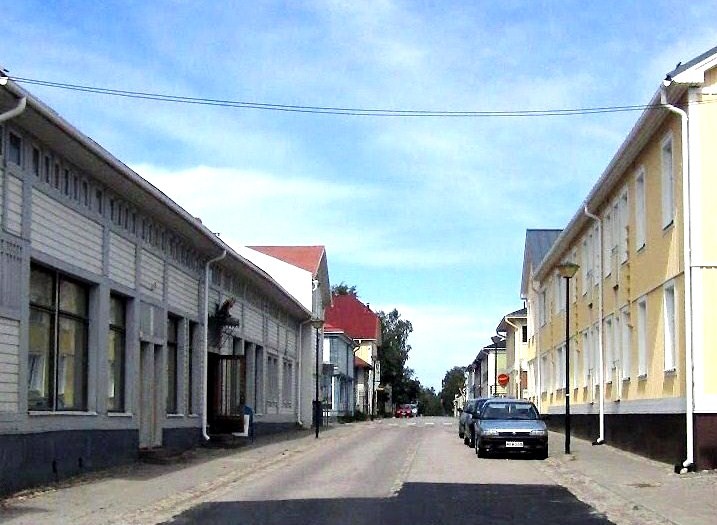
Raahe is a town and municipality on the west coast of Finland. Founded in 1649, it is one of 10 historic wooden towns remaining in Finland. After a difficult start, first suffering famine and then burned by russian troops, only by the end of the 18th century did Raahe begin prospering and thriving.


Raahe is located on the northern shores of Baltic Sea's deep Gulf of Bothnia, in Oulu province, just some 180 km south of the Arctic Circle.


Raahe is a seaside town better known for its old wooden town centre, parks and squares. Called 'Town of Sea Winds', Raahe offers plenty to any visitor - besides the heritage buildings, there are museums, galleries, churches...


Coordinates: 64° 41′ N, 24° 28′ E
                  (south of arctic circle - 65º N)
Population : ~26 000


Old Raahe (Vanha Raahe) features an unusual central square called Pekkatori (Pekka square), with closed corners, ispired in italian Renaissance grid-plan towns.

The corners are quarter-circle gardens.


Pekka square is the heart of Old Raahe; the neo-classical 1888 design was built over the previous Market Square. Streets run from the middle of each side, with an iconic house at each corner.

Old Raahe is noted for its Renaissance-inspired rectilinear town plan. The main historic streets run around Pekkatori and by the seafront.

Raahen Teatteri, Koulukatu 13

The Theater of Raahe is housed in a pretty 1913 building.
http://raahenteatteri.fi/drupal/

Koulukatu (School Street): the theater (right) and the primary school (bottom).

Alma, a small houseware shop just beside the Old Pharmacy.

Hairdresser, then the music school, in Brahenkatu

Art Nouveau, present in several buildings, as the Yard House, Brahenkatu 1

Kirkokkatu (Church Street) - a flower shop.

The Old Pharmacy (Wanha Apteekki) on the left side of Kauppakatu (Shop Street), from 1793.

The Old Pharmacy door.

Old Pharmacy museum containis one of Finland's most valuable collections of apothecary jars, as well as equipment used in the preparation of medicines, old wrappings and packages.

Kauppakatu, 36 : art nouveau by 64º N

In Brahenkatu, probably the most beautiful window in Raahe.

One of many examples of nordic "art nouveau".

Raahe's townhall


The old Railway Station is another fine example of wooden architecture, is now an art gallery:


A valuable Art Nouveau building from the early 1900s, the Rautatieasema was in decay; recently sold to a private owner, it is being restored as a Gallery plus craft shop and Café.

Galleria Asemamestari


The Church of Raahe

One of Raahe's two churches designed by architect Josef Stenbäck ; this was completed in 1912.


Art Nouveau style prevailed in Europe between 1890 and circa 1910. It uses motives from Nature, mainly plants, and materials like cast iron, glass and painted plaster, in rhythmically undulating and asymmetric patterns. Late 'art nouveau' was in use in more remote zones - throughout Russia, Norway (Älesund) or New Zealand (Dunedin).

The altar piece 'Awakening Hope' was painted by Eero Järnefelt in 1926.

The main chandelier

Pillar decoration detail.


Rantakatu, the seaside promenade

Raahe was born as a port city. In the late 1850s and on, shipping companies in Raahe owned Finland's largest fleet of sailing vessels. Currently, the port of Raahe is still a busy port, with 700 ships visiting each year.

Rantakatu (Beach Street) is the seaside promenade street, with museums and cafés.

Huvimylly, a movie theater. They named it 'Huvimylly' - Pleasure mill - because of the happy and long-awaited events taking place there.

Rantakatu 7


Rantakatu by late evening.


Raahen Merimuseo


The maritime museum (Merimuseo) was founded in 1862 in the old Customs House from 1848; it displays the oldest scuba diving in the world.

Rantakatu 33


The Raahen Merimuseo is the oldest museum of cultural history in Finland. The museum's pride is 'the Old Gentleman', the oldest diving suit in world, made of leather and dating back to the 18th century.


Café Ruiskuhuone, a pleasant waterside café in the Museum area.
Sovelius House

Presently, it's Raahe's oldest house, from the 18th century.


Sovelius House is a typical 1780's wealthy shipowner and merchant house, and now acts as a museum. The ground floor is in the Art Nouveau style, with rooms for changing exhibitions.


Upstairs, the restored 1890's living room is a veritable oasis of flourishing plants, furniture, exquisite upholstery as well as magnificent carpets, tablecloths and curtains.

Raahe under snow


In a sunny winter or spring day, Raahe shines in all its beauty.

Rantakatu, by the museum


Café Ruiskuhuone

Galleria Asemamestari (Station).

The campus behind the school.

Kirkkokatu.


The Church tower, Pekkatori square, Per Brahe statue - finnish heritage in the far North of Europe.


Per Brahe statue.

Other Finnish historic wooden towns are Kaskinen (Kaskö), Old Rauma, Porvoo (Borgå), Jakobstad and Vaasa.

See you, Raahe.


Tuesday, 13 January 2015

'Ukiorpoq', the winter has come.


I've been reading a collection of poems titled 'Ice - contemporary and traditional poems for the festive season', published by Pighog Press.


The opening poem is this well-known, sublime, unique work of genius:


'Blow, blow, thou winter wind'

Blow, blow, thou winter wind,
Thou art not so unkind
As man’s ingratitude;
Thy tooth is not so keen,
Because thou art not seen,
Although thy breath be rude.

Freeze, freeze, thou bitter sky,
That dost not bite so nigh
As benefits forgot:
Though thou the waters warp,
Thy sting is not so sharp
As friend remembered not.

 
William Shakespeare


That ingratitude of man, which 'freezes' the most Winterly moments of life, is also present in poems by Emily Dickinson, Robert Burns, John Keats...


In that little 'Icebook I also find Nancy Campbell, the contemporary English writer and poet who most dedicates to the Arctic - its people and its places, and the sensations one can experiment only in the frozen landscapes, in a blue-and-white palette under glacial windstorms. This is totally different poetry - the seven inuit words for Winter, sounding like ice-sharpened blowing blades:

'Seven Words for Winter'

ukiigatta last winter.
ukioq the winter; the whole year.
          ukiukkut in winter; during the year.
          ukiuuppaa the winter came upon her before she           reached home, or finished building her house.
ukiorippoq she has a good winter; it is a good winter.
ukiorpoq the winter has come.
ukiortaak the new year.


Nancy Campbell

Ukiorpoq


Someone found how to sing the cold, ungrateful nature of man as Shakespeare wrote:


Tuesday, 30 December 2014

Stornoway,
Hebrides' colourful little capital and a shopping paradise.


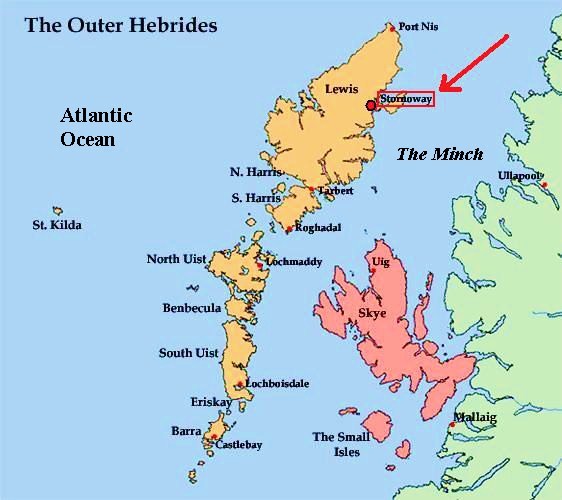
Stornoway is a town on the Isle of Lewis, in the Outer Hebrides of Scotland, and one of the most remote scottish towns.


It's the largest town in the Scottish Western Isles, separated from the mainland by the Minch, a strait of the North Atlantic ocean, probably created by the fall of a meteorite. Stornoway is linked to the north-west of Scotland by a two-and-half hours trip by ferry.


Stornoway is an important port, and the major town and administrative centre of the Outer Hebrides.


Coordinates:  58° 12'N, 06° 23' W
Population:   ~ 8 000 (urban area)

The frontline by the Minch's waters is also Stornoway's best historic heritage. The town has a distinctive Baltic profile.

The town was founded by Vikings in the early 9th century, under the name Stjórnavágr, Norse for "Steering Bay". It grew up around a sheltered natural harbour.


Stornoway grew as a fishing port through the 1700s; the 1800s saw the town take advantage of the herring boom, with as many as 6000 fishermen operating from the port during its peak.

Caledonian MacBrayde's ferry arriving in Stornoway


Today the harbour remains home to a significant fishing fleet, and busy with freight, ferry and leisure traffic.

Fresh seafood is always available at local markets and restaurants.

The famous townhall, an iconic building

The waterfront town center, around the Townhall.

Francis street: the Townhall at right, then the 1838 St. Peter's church neo-gothic tower - also a town's landmark.

Perceval Square, the crossing of Cromwell and Point streets. the commercial area.

The historic center, known as "The Narrows", comprises the commercial streets, like Cromwell, Francis and Point Street.

Point Street

Kenneth Street

The Narrows are pedestrianised, providing easy foot access to a range of shops pleasantly different from the usual in other towns.

'Hebridean Jewelry', Cromwell street: a distinctive seafront building.

The pink façade with wallhead gable, in the corner of the main street, reminds dutch architecture - Stornoway had historical links with Holland during the herring boom.

Baltic bookshop, Cromwell street.

'Mosaic', Point Street, for gifts

'Influence', Francis Street, one of the best shops in town.

The old Criterion bar, Point street.

This'n'that, Point Street

'By Rosie' - travel goods.

'The Stag', bakery and tearoom

Downtown department store.

This precious late 19th century blue house is now a restaurant. Also reminiscent of the dutch building style, with a shaped wallhead gable, this "town house" was also built for a rich merchant.

'Digby Chick' restaurant.


Old McNeill's pub, c. 1825, on the corner of Cromwell and Francis street.


The Royal Hotel Stornoway, with its 'HS-1 café bar'.

'An Lantair' art centre

An Lanntair is a multi-purpose arts centre comprising gallery, auditorium and cinema, bar and restaurant. Founded in 1985.


Also known as... "the lantern" !


Lews Castle

The neo-gothic Lews Castle was built between 1847 and 1857 as a country house. From the early 1950s until 1989 the Castle served as a College - Lews Castle College.


Lews Castle is presently disused, its interior in decay, waiting for a development project - a hotel maybe, a museum hopefully.


Visitors are free to walk around the extensive grounds which feature over 100 species of trees.

The entrance gate to the castle grounds.

The Woodland Centre


A pavilion built in the Castle grounds, conceived as a large timber framed glass barn. The magnificently located Café has superb views to Stornoway Harbour.


Museum nan Eilean


Museum nan Eilean was established in 1983 by the Western Isles Islands Council.

One of its main exhibitions was the Lewis Chessmen, a famous early medieval set of chess pieces of scandinavian origin, dating from about 1150- 1200 AD. Some pieces are to go on permanent exhibition at Lewis Castle.

Lewis Chess pieces, scarved in Walrus ivory.
http://www.nms.ac.uk/explore/collections-stories/scottish-history-and-archaeology/lewis-chessmen/

I shall publish soon a new post here, on the subject of the Lewis Chessmen.
As for now, I close with images of Stornoway in dim light:

The skyline as viewed from the castle.

And at sunrise.

Reflections in the low sun.

One of the most precious northen towns.