Thursday, 26 October 2017

The Norwegian Island of Peter I - a gloomy nobody's land in Antarctica


Peter I Island (Norwegian: Peter I Øy) is an uninhabited volcanic island in the Bellingshausen Sea, 450 kilometres from Antarctica. Along with Queen Maud Land and Bouvet Island, Peter I comprises one of the three Norwegian dependent territories in the Antarctic.


The island was first sighted by Russian sailor von Bellingshausen in 1821 and was named for Peter I (Peter First) of Russia. Drift ice made it impossible for Bellinghausen to come close to the island's coast.


Nearly all of the island is covered by a glacier and surrounded by pack ice, making it inaccessible almost all year round. There is little life on the island apart from seabirds and seals.

The volcanic island is dominated by Lars Christensen Peak.

Coordinates : 68° 51′ S, 90° 35′ W
                - south of the Antarctic Circle
Population :  0
Dimensions: 19 km long, 11 km wide


In the Arctic, at this latitude North, you can find several inhabitated settlements, even small towns. Not in Antarctica. Here there is only barren, rugged glacial coastline surrounded by ice cliffs and bergs; even the volcano that once formed the island, and is its central core, is covered by a thick ice-cap that slides steeply down to the sea.

Auststupet, mountain cliffs along the steeper eastern side.

The ice edges fall vertically into the surf waves crashing down with huge force.


The North tip is gentlier sloped.

Cape Ingrid, a rocky peninsula on the west side. Narrow strips of beach suitable for landing surround the cape.

Simonovbreen glacier, on the northeast side.

In the surf, large blocks of ice floe.

After Bellinghausen sighting no one set foot on the island until 1929; the first landing happened when an expedition led by Nils Larsen and Ola Olstad, financed by whale-ship owner Lars Christensen, succeeded in getting ashore. They claimed it for Norway, who annexed it in 1931 by a royal proclamation declaring the island under Norwegian sovereignty.

Since then there have been several landings on the island by various nations for scientific investigations.

The automatic station, with the Lars Christensen peak in background.

In 1987, the Norwegian Polar Institute sent five scientists to spend eleven days on the island. The main focuses were aerial photography and topographical measurements to allow for an accurate map of the island. The second important area was marine biological investigations. The team also installed an automated meteorological station on the island.

But usually the few who come here measure their stay in the hours.


The best access is provided by helicopter capable of landing on the low ice cap near the northern tip of the island.


The Base Camp of DXpedition 2006 on the glacier

Radiosletta plateau, provides the best landing site for helicopters, except under the frequent katabatic winds.

On the only beach where you can go ashore - the bay of Sandefjordbukta - great surf waves usually break violently.

The tallest peak is the Lars Christensen Peak at 1 640 meters. This summit is a 100-metre wide circular crater. It's a shield volcano, wide and low. Dated samples range from 0.35 to 0.1 million years old.


The scarce island's vegetation consists exclusively of mosses and lichens which have adapted to the extreme Antarctic climate. Strong freezing winds, steady snowfall keep vegetation to a minimum.

The island is a breeding ground for a few seabirds, particularly southern fulmars, but also petrels and Antarctic terns. There are numerous seals

Southern giant Petrel

Antarctic Fulmar

Lars Christensen peak in the low Sun.

Light is often magic at this latitude

Austral lights in Bellinghausen.


Saturday, 21 October 2017

A straight line through the Arctic visits U.T.


A pretty screenshot of a very recent visitors' map shows this lovely straight line from Hay River, Canada to Finnsness, Norway; on its way stand Arviat, Canada; Inuvik, Canada; Nuuk, Greenland, and somewhere in Iceland. A fine route for Ultima Thule.


Soon I'll be posting about Siglufjörður, in Iceland, a quite pretty and cold arctic village which stars in the thrilling TV series "Trapped".


Thursday, 21 September 2017

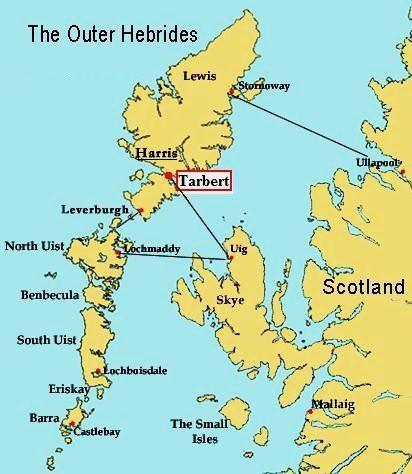
Isle of Harris, Outer Hebrides - Tarbert, a little harbour town, and the amazing St. Clements Church


The geology of these Islands is 3 billion years old - in fact, this is one of the oldest territories on Earth. The Isle of Harris is northernly, remote and rich in History, that's what Ultima Thule is all about.


Lying in a valley where North and South Harris meet, and set against a backdrop of rugged mountain peaks, Tarbert is the island's main port and capital village.

The Caledonian ferry at Tarbert, Harris

Tarbert lies on the shores of Loch Tarbert, and South Harris avoids becoming an island by just a few hundred yards of land over which the Vikings would drag their longboats into West Loch to avoid sailing around via the Sound of Harris.

The Caledonian ferry has daily calls at Tabert harbour

Tarbert, Isle of Harris

Coordinates: 57° 53′ N, 6° 47′ W
Population:  ~500

Pier Road, the town center: Hebrides Hotel (long, white), the Tarbert store (yellow), the Tourist information center (beige, right).

There are two villages on the Isle of Harris, Tarbert and Leverburgh (in the south).  Tarbert lies on a narrow strip of land.  The name Tarbert means “portage” or “ithsmus”.


Tarbert has most things that a person needs:  besides the Tourist Information Centre (above), there is a small bank, post office, a hardware store, two hotels, a coffee shop, two grocery stores, a gift shop, the Harris Tweed shop, a fish & chips.

The famous Tarbert Stores

The Tarbert Stores, where you can find almost anything except food.

On Pier Road, Tarbert Stores is specialized in supplying the needs of fishermen and other tradesmen. This simple timber construction is thought to have been built ca. 1900 with timbers deriving from Swedish origins as return ballast from ships exporting fish.

A traditional house and fishing hardware shop and ironmonger, also providing electrical services.


Heading now for the First Fruits Tearoom, a local must, with a gourmand offer in a friendly cozy atmosphere.

The tearoom is installed in Pier Road cottage.


First Fruits is a very popular place to spend some time waiting before the ferry leaves, if you can find a seat.


Main Street (or High Street) is a long and rather straight street from Pier Road to the Harris Tweed Shop, further west.

A yellow Hostel on Main Street

Main Street in a rainy day, as is quite often the case.

Buth Bheag, candles and fragrances, on Main Street.

There are several alternatives for guest accomodation, from Hotels to hostels and B&Bs;  the Harris Hotel is surely one of the best offers.

The family run Harris Hotel has been welcoming holidaymakers to the island for over a century.

The garden room.


Tarbert was founded as a fishing village in 1779, mainly for herring. From 1840 a new pier in Loch Tarbert allowed for a weekly mailboat service. By 1894 Tarbert was the main settlement on Harris, and a few years late Harris Tweed mill was set up here.

Tarbert harbour is the island’s main ferry terminal and also serves for boat tours to colonies of puffins and razor bills.

In 1964 the MacBrayne ferry started service on the Tarbert route. Fishing decayed and the port's main activity is now the loading and unloading of goods.

But Tarbert is mostly known as the home of the Harris Tweed Mill. This mill was established during the 1900s and became a major industry in Tarbert at the time.

Harris Tweed Shop


http://www.harristweedisleofharris.co.uk/index.php/27-harris-tweed/103-harris-tweed-isle-of-harris


Today the Harris Tweed shop is opened on the main road running toward the ferry terminal.

A tweed cloth handwoven by islanders at their homes in the Outer Hebrides.


Tarbert's Church of Scotland, built ca.1860.

Main Street and the port by twilight.


The Isle of Harris is one of the oldest geological terrains in the world, mostly ondulating rocks of gneisse covered with moss and dry grass, or flat wet moorland.


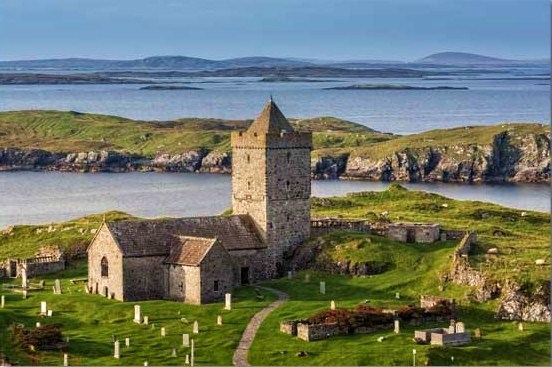
St. Clements Church,
 or Tur Chlíamainn, in Southern Harris


St. Clements Church, dedicated to the patron saint of seafarers, is situated in Harris Island's southern tip, some 30 km south of Tarbert, and dates from the end of the 16th century.


The tower was built on the top of a rocky outcrop, a higher level ground than the nave.


St. Clements church is widely thought to be the grandest medieval building in the Outer Hebrides. The heritage building is now in the care of Historic Scotland.


Medieval celtic cross.


The interior of the church is impressive and atmospheric, and contains the finest examples of late medieval sculpture in the Outer Hebrides.

The carvings.

This is the finest medieval wall tomb in Scotland, crowned by an arch and ornated by elaborate carvings of biblical design.

The arched recess of Alasdair Macleod's tomb (1528), in the south wall.


The arch surmounting the tomb has some unique Carvings with Gothic and Celtic motifs.


A sailing galley in the 1500s.


The pretty Razorbills

Besides Puffins, the Razorbills are a Nature attraction for tourists in the Isles.