Wednesday, 20 February 2019

Siglufjörður, a fishing village at 66º N under Northern Lights


Iceland is a country in progress. From a remote half-unknown island, a desolate treeless land of volcanoes, canyons, torrents and waterfalls with a few small fishing villages along the coast, Iceland has been changing rapidly into a modern country where the savage Nature is a plus to civilization; the coastal settlements are now coulourful and pretty, culturally eventful, displaying all modern comfort and facilities.

The island's circular road has been improved with tunnels, so that travelling is also easyer. This region of the extreme North, where Akureyri is the main thriving town, offers some of the best landscapes and attractive villages.


In the northern coast of Ireland, just a few miles south of the Arctic Circle and west of the large Eyja fjord, Siglufjörður is an old small fishing town that has become recently seeked for thanks to the viewing of Auroras - it's a privileged viewing point, and visitors from all the world are coming for the show.


Siglufjörður was inaccessible by road until 1940, but can now be reached via new tunnels linking to the main northern road, and has been improved with museums, cafés and a few shops, a new hotel and modern restaurants. All that, keeping alive the traditional fishing activities.

A string of tunnels now allows access from/to the East.

Siglufjörður is located on the left bank of its own narrow fjord, and surrounded by steep mountains.

A scenic little arctic town


Siglufjörður, northern Iceland

Coordinates: 66° 11′ N, 18° 53′ W
           (22 km south of the arctic circle)
Population: ~1300

All these waterfront buildings from the old fisheries are now part of the Museum complex.


The town center: Museum, church, main street
 
Aðalgatan, the oldest street

Aðalgatan, from the shore to the church.

The modest but coherent church from 1890.

The church tower in late August

The local administration and the residents keep renovating some of the old houses, so the town looks almost brand new.


A typical Icelandic corner

The Sæbyhús from 1886, in Norðurgata - one of the oldest houses in town, now declared heritage.

An Icelandic beauty.

Henriksen house, the best house in town, in Aðalgata.

The magnificent house was built for a Norwegian herring trader. and is now a fine Hostel.

'Gistihús Soffía', also in Aðalgatan.

View from a window at Soffia's guesthouse

Torgið restaurant

A small shop in Suðurgötu

Hjarta Bæjarins, Aðalgata - wool knitting, design, crafts and gifts


The port and leisure area

In the last century, the town experienced dramatic changes (that can be viewed in the Herring Museum). At one point, it was the busiest place in Iceland during summer and the center of the booming herring industry.


But the port keeps a strong local position for fishing cod, haddock, saithe, redfish, halibut, and also shrimp, flatfish, lobster. Freezing industry is also at full work, and Siglufjörður is still the largest cod landing port in Iceland.


The 'Júlíus Geirmundsson', a trawler from the local fleet.

The red, the yellow and the blue

Three fishing warehouses were converted for leisure and tourism as cafés, art galleries and other events. Each one painted in a different (bright) colour.


Hannes Boy café

Behind the Rauðka (red) and the yellow, there is the Bláa (blue) house


Jolamarkadur - the Yuletide Market

Christmas market Jólamarkaður


The Herring Era Museum


The Museum is installed since 1994 in warehouses that were part of an old Norwegian herring station. The assembly, construction and installation of the Museum was completed in 2003.


The three exhibit buildings tell the stories of the people who worked in the herring industry, of the factories and products, and of the fishing work and fishing boats.

Museum Síldarminjasafnið (The Herring Heritage)


The three buildings are the Salthúsið (Salt house), the Grána fish processing house and the larger boat house Bátahúsið.

The main building is a salting station from 1907. In front there is an old pier with work stations for the salting process


The fish processing provided herring to export to Europe and North America in the form of fish meal for feed and fertilizer; and fish oil, for use in all manner of household products, from floor wax to hair cream.

Grána fish factory, 1930-50

Products from the factory

The Boat House displays boats and trawlers, equipment and scenes of the daily fishing life.


"Herring ball in Siglufjörður" (1918) by Muggur, in the Herring Museum.

The Boat House reflected on the waters of the fjord.


The Folk Music Center

When visiting the Folk Music Center guests get an idea about Icelandic folk music, hearing local people singing traditional rhymes and folk songs.


The Folk Music Centre in another of Siglufjörður’s oldest houses, the Madame House (Maðdömuhús,1884).


The Icelandic Poetry Center, "Ljóðasetur islands":

http://ljodasetur.123.is/

Ljóðasetur islands offers the opportunity to browse poetry books and experience live events.


A bookshelf of Icelandic literature


The Siglufjörður Hotel


In summer, an outdoor café

Warm interior, Nordic design at its best.

Also a warm outdoor pool with a view.


Skarðdal forest, at 66° 8' N

A program of forestation has been developed at Skarðalur, near Siglo; the forest 'opened' in 2015, and it's the northernmost planted forest in Iceland, reaching Arctic latitudes. Mainly birch, spruce, pine and larch have been planted, and the system reached a development allowing for leisure, with nature paths for visitors.


The fiord forest in glorious spring.


Finally, some Aurora fotos from Siglufjörður and surroundings:


What a wonderful, magic place this is, don't you agree ?

Tuesday, 1 January 2019

NASA quoted Ultima Thule !!


Wow ! NASA called the very very remote cosmic stone visited by its probe New Horizon, launched in 2006, as 'Ultima Thule' ! What an honour to this Blog ! :)))

Named technically as Kuiper Belt Object MU69, the asteroïd-like object beyond Pluto, in the outer edge of Solar System, deserved the special nickname reserved to new discoveries in farmost regions of the known world.

The faint light is our Sun, as seen by a graphic artist from the newly named Ultima Thule.


Monday, 24 December 2018

Illustrated Selected Poems by Robert Frost: a most beautiful book gift


This 2017 edition by Sterling (New York) of Robert Frost poetry, with woodcut illustrations by Thomas W. Nason, is one of those rare books you cheerfully keep forever, a pleasure to handle and slowly turn the pages.


A Patch of Old Snow

There's a patch of old snow in a corner
         That I should have guessed
Was a blow-away paper the rain
         Had brought to rest.

It is speckled with grime as if
         Small print overspread it,
The news of a day I've fogotten
         If I ever read it.


The Telephone

"When I was just as far as I could walk
From here to-day,
There was an hour
All still
When leaning with my head against a flower
I heard you talk.
Don’t say I didn’t, for I heard you say—
You spoke from that flower on the window sill—
Do you remember what it was you said?"

“First tell me what it was you thought you heard.”

“Having found the flower and driven a bee away,
I leaned my head,
And holding by the stalk,
I listened and I thought I caught the word —
What was it? Did you call me by my name?
Or did you say —
Someone said ‘Come’ — I heard it as I bowed.

“I may have thought as much, but not aloud.”

“Well, so I came.”


A Time to Talk

When a friend calls to me from the road
And slows his horse to a meaning walk,
I don’t stand still and look around
On all the hills I haven’t hoed,
And shout from where I am, What is it?
No, not as there is a time to talk.
I thrust my hoe in the mellow ground,
Blade-end up and five feet tall,
And plod: I go up to the stone wall
For a friendly visit.


The Road Not Taken

(...)
Two roads diverged in a wood, and I -
I took the one less traveled by,
And that has made all the difference.


Happy Christmas and many nice new readings!


Friday, 7 December 2018

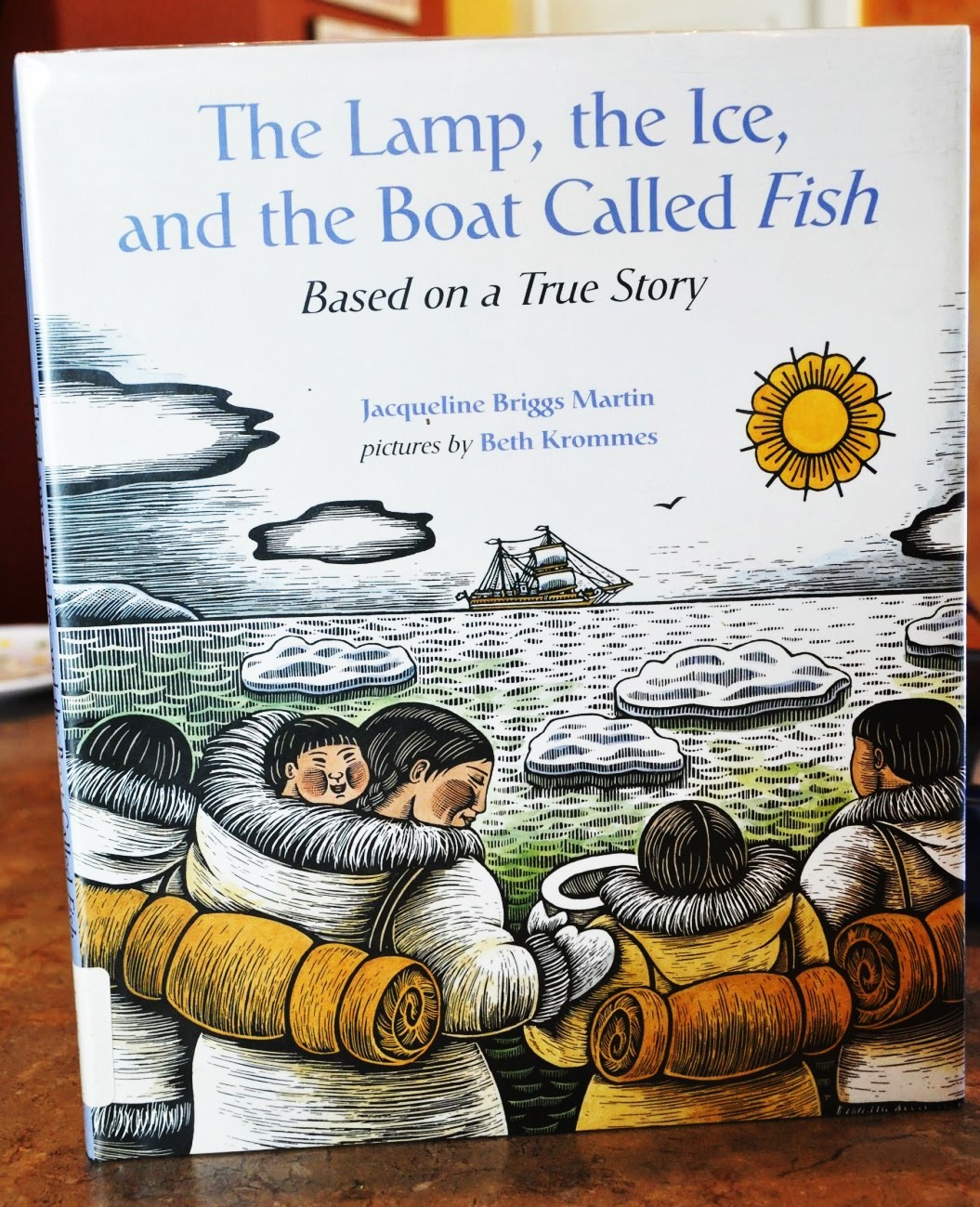
The Lamp, the Ice and the boat called 'Fish' : an Arctic Yuletide gift


The Lamp, the Ice and the boat called Fish is an illustrated book that tells an Inupiaq inuit tale: the story of the Karluk journey in the Arctic Sea as seen by a native girl's perspective.

The Karluk (=fish) was one more whaler steamboat stuck in ice and then sunk as attempting an adventurous expedition in the far North. She sailed from Nome, northern Alaska, as part of the Canadian Arctic Expedition. Departing in 1913, the Karluk sailed north and stopped at Barrow (*), where a native Inupiaq family with a newborn girl, Mugpi (Makpii), joined the crew aboard to help with their knowledge and capabilities in Arctic ice surviving. 


But after Barrow the Karluk was stranded by compact ice, then drifted westwards across the Chukchi Sea and finished sinking near Wrangel Island. Most of the crew from the ship set out for a journey through 130 km of pack ice to reach Wrangel's solid ground. There they built a camp and fought to survive, hunting and fishing until rescue finally came in September 1914. But few had made it. Disease, canned food poisoning, cold and accidents had taken the life of most. Among the 14 survivers was the Inupiaq family of four, and the ship's cat !


Several serious books tell the story of the Karluk expedition; but the perspective of the native girl is what matters in "The Lamp, the Ice and the Boat Called Fish", an adaptation by Jacqueline Briggs Martin for children/teenagers with fantastic illustrations by Beth Krommes.

Winter came early in 1913,
and soon the captain
was steering the ship between huge chunks of ice

- some as big as houses.


The crew and scientists used boxes and barrels
to build the walls of a house on a large ice floe

not far from the ship.

One day in January 
Kurraluk, Kataktovik, and five of the crew left to find Wrangel Island.
The Inupiaq men knew how to travel ove sea ice with dogs and sleds.


She had to wear goggles, too. Otherwise, the sun and snow
would cause snow blindness. Some wore goggles of amber glass.
Makpii didn't have to wear so many clothes
because she rode inside her mother's parka.


One morning in September
Qiruk, Makpii and Pagnasuk fished for tomcod
and caught enough for breakfast.


Of course all ends well for Makpii, her Inupiaq family and the cat !

Have a cosy, friendly, happy Yuletide !

(*) now Utqiagvik

more: