Sunday, 28 January 2024

The Selkie Woman of Mikladalur, Kalsoy


I am absolutely fascinated by these sparse rural villages on the Faroe Islands, with their wooden houses painted in tar-based black and covered by grass roofs.


Currently most villages there are served by roads and many have helipads, so the isolation is no longer what it was when connections could only be made by sea; the easier access shows, for example, in the rise of accommodation and restaurants all around. It has also brought artists that leave their works on Faroese folklore.

Mikladalur is located on top of a cliff, with access to the sea by a slipping ramp. But it's most famous for a beautiful bronze sculpture of the legendary Seal Woman, a Nordic mermaid, standing on rocks at sea level, facing a waterfall from above the rocks.


Mikladalur is older than expected: it is already mentioned in writings from 1298, in the island's sheep and dog count. Later, in 1584, there is a register of owners that also mentions the first village assembly, in the churchyard, in 1646. 

After centuries of farming and herding, as Mikladalur was well located close to some fishing banks, it became a fishing port in the 19th century. Then the village grew with people who came from other villages for the  seafaring jobs. The village first school was built in 1885. Another activity at that time was bird hunting, also bringing an important income to the village. The road arrived only in 1980, and life has changed since then. Even a café has already opened there.

Mikladalur, island of Kalsoy

Population: ~30
Coordinates: 62° 20' N, 6° 46' W


The stone church was built in1856


Nornðástova Smithy, the blacksmith forge, is a red-painted stone house with a grass roof; for some time it was a center of activity on the island, teaching the profession to many apprentices. They made hooks and harpoons for whaling, knives, sickles and even eyeglass frames.


The Smithy closed in the 1970s, but the furnace and wheel still function; they are now protected by a grass covered roof. It remains in the Norðnástova family.

A water mill can also be seen downstream on the brook that flows through the village. Every village on the island had one, for grinding grain - barley and corn., 


Kópakonan, the Selkie of Mikladalur.

The legend of the Faroese Seal Woman was immortalized in bronze with a sculpture by Hans Pauli Olsen in 2014, on a low rock next to the village gate. The framing is spectacular.


The statue of the Seal Woman was erected on a rocky knoll, Stórakneysi, at the village shore. I will publish the legend in a following post. 

Another unusual feature of Mikladalur is a small forest; it is well known that in the Faroes, trees are absent in nature, they are only found in plantations. That's why this little forest is so valuable:


The tree line in the Faroe is about 200 m above the sea. This plantation was made at an altitude of 100 meters, southeast of the village, on the banks of a small stream. It was started in 1953, and consists of dune pine, Japanese larch and spruce varieties.


Kallur, the headland north of Kalsoy island


The northern half of the island of Kalsoy rises more than 200 meters above the sea. The peak of Nestindar reaches 788 m.


Rugged cliffs covered in layers of greenery rise towards a sky that seems to merge with the sea. The route along the cliff crest to the Kallur Lighthouse is as dangerous as it is irresistible.


Monday, 20 November 2023

Inndyr and its medieval Romanesque church at 37º N, in Gildeskål


On the Arctic coast of Norway sits a Romanesque church from the 12th century. Well, I had to show this remarkable rarity. 


Inndyr, in the coastal region of Gildeskål, is one of those many picturesque marine villages in Norway; founded and grewn off fishing, a little south of the Lofoten archipelago. 


The recently restored 'Tormodbrygga', a typical fishing pier in the small port of Inndyr.

Tormodbrygga pier, built on the Lofoten Islands in 1900, was purchased and transported by a merchant from Inndyr, where it served as a warehouse and store. It was then managed by his son Tormod, who also lived there, until the store closed in 1952. Now it will be a place for nautical clubs and leisure activities.


But what makes Gildeskål worth highlighting is the Romanesque church on the outskirts of Inndyr, at 67º 3' N, 14º 2' E, well above the Arctic Circle, and much further north than the most famous Trondheim's Nidaros Cathedral. 

The old church of St. Thomas of Canterbury


Around 1130, a church began to be built about 2 km north of Inndyr, which in 1170 was dedicated to St. Thomas av Canterbury (Thomas Beckett), who died on that year. After several fires, in 1710 the interior was partially burned, and the restoration was made in the baroque style of the 18th century.


Strangely enough, this church was built from marble stone found on a nearby beach. It is the only marble stone church at these latitudes. The slabs and ashlar stones are not polished, they are roughly hewn.


Stonemasons among the best in medieval Europe certainly came to Gildeskål; and later the church was decorated with one of the richest baroque interiors in the country. 


All Scandinavian churches (but many French ones too) have their votive boat; this is from 1782, a model of the danish/norsk frigate Joshua which sank in 1566 during a storm at Visby. 

 
Now it's time for a coffee pause. Espresso? maybe in the Heimsjyen


Quite nice for such a tiny village.


In Gildeskål there is another wonder - the island of Fugløya and the village of Sørfugløy.   


Hugely isolated due to its distance from the mainland coast, it is an idyllic place that has been attracting rich people who escape the urban hustle and bustle and want peace, security or seclusion. Paradise has a branch here.


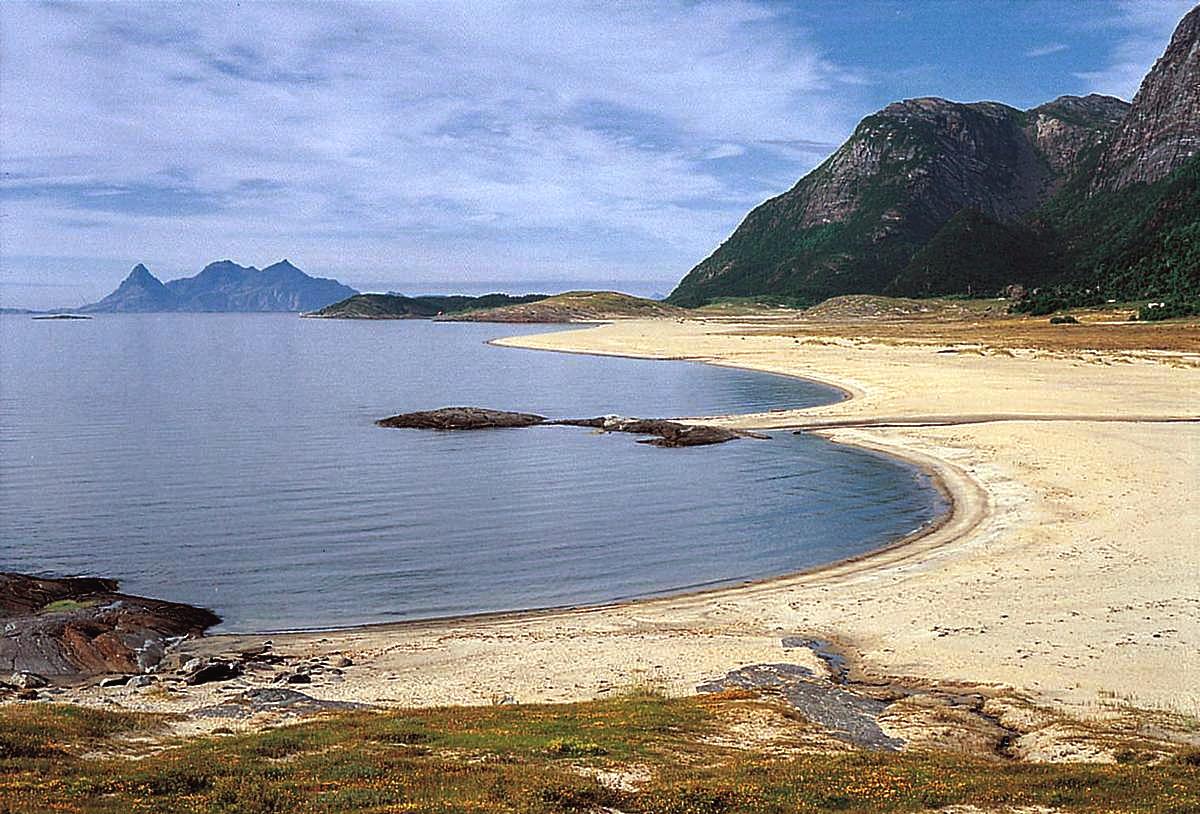
A wonderful sand beach in arctic cold waters.
 
Midnattsol on Fugløya


Monday, 4 September 2023

Seyðisfjörður, pretty village in East Iceland


Seyðisfjörður or Seydisfjoerdur is a town and municipality in Iceland's Eastfjords region, at the innermost point of the fjord of the same name.


Connected to Scotland and the Faröe, this is a typical icelandic village, with a tiny port deep into the fjord, surrounded by mountains and wild waterfalls.


Settled at the sandy bottom of the fjord, it's almost unreally pretty in the unspoiled breathtaking landscape.


Seyðisfjörður

Coordinates: 65°15′ N, 14°0′ W, just one degree below the Arctic Circle.
Population:  ~ 670 inhabitants.


The town was settled by fishermen from Norway in 1848, on the lowlands of the fjord, where a few farms had existed for centuries. These settlers also built some of the present day wooden buildings.


Seyðisfjörður has a library, a hospital, a post office, some retail activity, a visual arts centre, a Technical Museum and still a local heritage museum, the only two cinemas in the east of Iceland, three small hotels, a swimming pool ! Not so tiny, so.

The Blue Church (Bláa Kirkjan) is the absolute central landmark.


Legend tells that the church, from the 13th century and dedicated to St. Mary, has been moved several times; it was surely moved into Seyðisfjörður in 1921, but after so many changes and a fire no one knows what remains from the original medieval church, maybe just some of the wooden walls.


A praised concert season takes place each summer at the Blue Church.

https://www.facebook.com/blaakirkjan


As tourism is replacing the traditional fishing activity, hotels are growing in number.


This wooden house in blue is the old Pharmacy.

  The old Post Office is now a small Hotel.

19th century, Norwegian style.

Wooden house in red...the Music School.

The Norwegian-built houses are the real treasure here.

Kaffi Lara


The café in town 
- this is Kaffi Lara, at Norðurgata


The small harbour is still active with a few fishing ships, but presently it is also dedicated to tourism and leisure.


The Smyril Line MS Norröna keeps a daily link to Denmark and the Faroe Islands.

The Skaftfell Art Centre

Amazingly, the town also has an Arts Centre:


Skaftfell is a visual art centre to encourage the development of contemporary art. It is a meeting point for artists and locals and its activities are based on exhibitions and events, and also an international residency program.

 
The Centre is installed in a 1909 Norwegian house.

Some of Iceland´s best waterfalls are located in the vicinity of Seyðisfjörður.
 
This is Gufufoss, 19 m high
 
----------------------
The first telegraph cable connecting Iceland to Europe started in 1906 from Seyðisfjörður, built by
Great Nordic Telephone Company.
For several years this was a hub for international telecommunications.
----------------------